Introduction
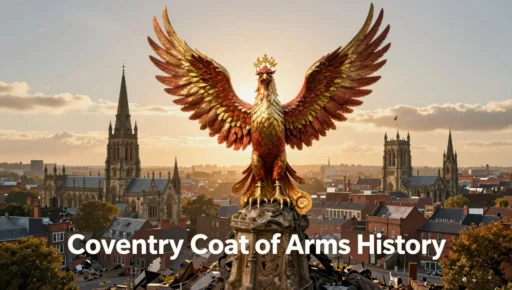
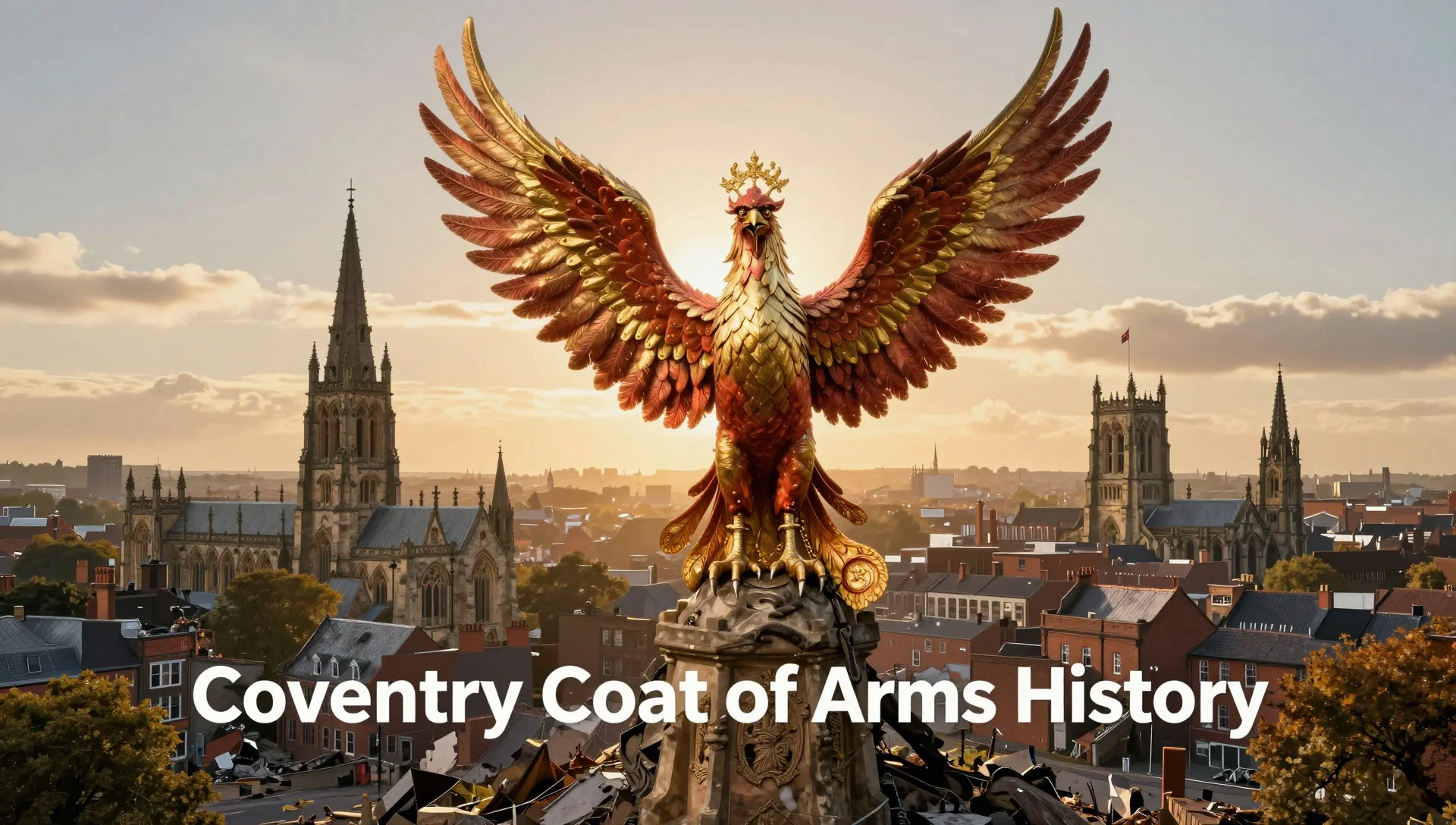
A Phoenix is a striking choice for a city symbol: it is mythical, dramatic and closely associated with rising again after destruction. In Coventry, its meaning is especially powerful. The bird was proposed for the city’s arms in the years following the Second World War, when Coventry was rebuilding after severe wartime damage.
In this guide to Coventry Coat of Arms History, I’ll look at the account shared by Etch & Pin in 2019, including the role of Reginald Trotter, who suggested adding the Phoenix. I’ll also explain what the symbol can tell us about civic identity—and where the available story leaves questions unanswered. That distinction matters: it lets us appreciate the emblem without treating every detail as settled fact.
What is the Coventry coat of arms?
A coat of arms is a distinctive design used to represent a person, family, organisation or place. In the case of a city, it can act as a visual marker of civic identity: something that links the local authority, the community and the place’s history.
People sometimes use the words coat of arms, crest and emblem as if they mean exactly the same thing. In heraldry, however, they refer to different parts or kinds of designs. A coat of arms usually means the formal heraldic achievement, while a crest is technically one element associated with it. In everyday conversation, “city crest” is often used more loosely for a civic symbol.
That distinction is useful when researching Coventry’s symbol. The 2019 Etch & Pin article refers to the historical Coventry Coat of Arms and reports that a Phoenix was added to it. It does not give a full heraldic description or reproduce the formal wording of the arms. So, I would avoid guessing at colours, shapes or other details unless I could confirm them from an authoritative record.
Coventry before the Phoenix design
The Phoenix was not simply a decorative bird chosen at random. According to the Etch & Pin account, Reginald Trotter proposed a change to Coventry’s Coat of Arms in 1957 to symbolise a “new Coventry”. That wording points to an important distinction: the proposal was a change to an existing civic design, not the creation of Coventry’s identity from scratch.
The source does not describe the earlier arms in detail, so it would be unwise to fill in the gaps with confident-sounding guesses. For readers studying the design, a good next step would be to consult a formal civic or heraldic record for the complete description and history. That way, the story of the Phoenix can be placed alongside the full evolution of the city’s arms.
This is a practical lesson for local-history research more broadly: separate what a source directly documents from what you infer. Here, we can say that the Phoenix was proposed as an addition in 1957. We should not claim, based on this account alone, exactly what every earlier element represented or how the complete design changed.
Coventry’s post-war rebuilding
The Phoenix makes sense as a symbol because it is widely associated with renewal after destruction. That meaning had a particular resonance in Coventry following the Second World War. The city suffered heavy damage during wartime bombing, and the post-war years brought the demanding work of rebuilding homes, businesses and public life.
The 2019 article connects the proposed Phoenix with that recovery, describing it as a symbol of the city’s resurgence after the devastation of the war. In Tayzia’s account, the bird represented a new Coventry “reborn out of the ashes of the old”. It is a memorable image, and it explains why a mythical creature could feel appropriate on a civic emblem.
The symbol does not mean the city simply returned to how it had been before. Rebuilding involves loss as well as renewal. The Phoenix can be read as an expression of hope and determination, while still leaving room to remember what had been destroyed and the people affected. For a school project or local-history display, that balance makes for a more thoughtful explanation than saying only that the city “started again”.
Reginald Trotter’s 1957 proposal
One of the most personal parts of the story is how it reached Etch & Pin. Tayzia, who is identified in the article as the owner of @fantayziadesigns at Fargo Village, contacted the business to explain that her grandfather, Reginald Trotter, had first suggested adding the Phoenix to Coventry’s arms.
According to Tayzia, Trotter made his proposal in 1957 and also helped work on the design. Her account gives the story a family connection as well as a civic one: the symbol on the city’s arms was linked to someone in her family, and she said she was pleased to see it featured on a badge.
It is worth being precise about attribution. The article reports Trotter’s role through his granddaughter’s account; it does not present a full council file, design brief or interview with Trotter himself. That does not make the story unimportant. Rather, it shows why family recollections can be valuable—and why it is helpful to identify them as recollections when writing history. If I were preparing a formal report, I would use Tayzia’s account as a starting point and look for records that document the approval process in more detail.
From proposal to approval: the key dates
The reported timeline is brief but clear. Tayzia said it took two years for the proposal to go through. After the arms were signed and delivered in February 1959, Trotter was presented with an Address of Appreciation by the Lord Mayor on behalf of Coventry’s citizens.
| Date or period | Reported event |
|---|---|
| 1957 | Reginald Trotter proposed adding a Phoenix to the city’s arms. |
| The following two years | The proposal went through its approval process; Trotter also helped with the design, according to Tayzia. |
| February 1959 | The arms were signed and delivered. |
| After delivery | The Lord Mayor presented Trotter with an Address of Appreciation on behalf of the citizens. |
This timeline helps distinguish the suggestion from its formal progress. The Phoenix may be the most visible part of the story, but the process matters too: a civic symbol is not just an individual’s idea; it becomes meaningful through adoption and public recognition.
The source does not spell out each step between the 1957 proposal and the 1959 presentation. So, the table shows only the milestones it reports, rather than filling in an approval procedure that the article does not describe.
What the Phoenix represents
At its simplest, the Phoenix represents renewal: the idea that life can continue after devastation and that a community can rebuild. For Coventry, the symbol has an additional local meaning because the proposal was explicitly connected with the city’s recovery after the Second World War.
I find the most helpful way to explain it is to connect three layers:
- The mythical image: A Phoenix is associated with rising again after its destruction.
- The historical context: Coventry was rebuilding after severe wartime damage.
- The civic meaning: The bird expressed a hopeful vision of a “new Coventry”, in Tayzia’s description.
There is also a difference between what the symbol means generally and what its designers intended in this particular case. The broader association between Phoenixes and rebirth helps us understand the choice, while Tayzia’s account explains how the proposal was understood in relation to Coventry. Keeping those layers separate avoids overstating what the source says.
The design’s message is hopeful, but it need not erase the difficult history behind it. A strong civic emblem can commemorate resilience and invite remembrance at the same time. That is one reason the Phoenix continues to offer a concise way to talk about Coventry’s post-war identity.
How to read the emblem accurately
When researching a coat of arms, it helps to keep the visual design, the official description and later interpretations separate. They are related, but they are not interchangeable.
| Term | What it generally means | How to use it when writing |
|---|---|---|
| Coat of arms | A formal heraldic design associated with a person or place | Use it for the official civic arms. |
| Crest | Technically, one part of a heraldic achievement; often used informally for a whole emblem | Clarify whether you mean the formal element or the design in everyday speech. |
| Phoenix | A mythical bird commonly associated with renewal | Explain its symbolism, then connect it to the reported Coventry story. |
| Civic emblem | A broader term for a symbol representing a town or city | Use it when discussing public identity without making a technical heraldic claim. |
If you are using an image in a presentation, check whether it is an official version and whether it has been reproduced accurately. For a written project, cite the source for the 1957 proposal and the 1959 presentation. A simple note such as “Tayzia’s account, reported by Etch & Pin in 2019” makes clear where that information comes from.
This approach is especially useful online, where a badge, illustration or simplified logo may be mistaken for the formal arms. A picture can be a good starting point, but it is not always a complete historical record.
Why the Phoenix still matters today
Local symbols have a way of carrying big ideas in a small space. A Phoenix badge or city image can prompt questions about Coventry’s history, the war and the work of rebuilding. That makes it useful not only as heraldry but as a starting point for conversation.
For example, a teacher might ask pupils why a city recovering from wartime destruction would choose a bird associated with rebirth. A family visiting a local exhibition could compare the symbol with stories passed down through generations. A designer creating a local-history display could pair the image with a short, carefully sourced timeline rather than relying on the picture alone.
There are practical ways to explore the story further:
- Look for the formal city arms and check the source of any image you use.
- Compare the 1957 and 1959 milestones with other local-history records.
- Label family accounts as personal recollections, rather than official documents.
- Ask what the symbol communicates to people today as well as what it meant when adopted.
The story is also a reminder that civic identity can be shaped by ordinary people, not only by institutions. According to Tayzia, her grandfather suggested the change and helped with the design. That human connection gives the emblem a personal dimension alongside its public meaning.
Benefits and limitations of the story
The story has several strengths. It explains why the Phoenix was chosen, offers a clear timeline, and identifies a person associated with the proposal. Tayzia’s family connection also gives the account a human voice that a dry list of dates might lack.
At the same time, one short article cannot answer every historical question. It does not provide the full heraldic description, reproduce the original proposal or detail every stage of approval. The timeline is based on what Tayzia told the publisher, so readers seeking a complete formal history would benefit from checking further records.
Pros
- Connects the Phoenix with Coventry’s post-war recovery.
- Names Reginald Trotter as the person who suggested the addition.
- Gives key dates: the 1957 proposal and February 1959 delivery.
- Preserves a family account that adds personal context.
Cons
- Does not describe the earlier arms in detail.
- Does not outline each stage of the approval process.
- Does not include the formal heraldic wording.
- Relies on a brief reported account rather than a complete archive.
Being open about those limits makes the history more trustworthy, not less. It lets readers enjoy the story while understanding which details are documented in the article and which could use further verification.
FAQs
When was the Phoenix proposed for Coventry’s arms?
The account published by Etch & Pin says Reginald Trotter proposed adding the Phoenix in 1957. Tayzia, his granddaughter, said the proposal represented a new Coventry after the devastation of the Second World War.
When were the arms signed and delivered?
Tayzia’s account says the arms were signed and delivered in February 1959, after a process that took two years. The article does not set out every approval step between the proposal and delivery.
Who suggested adding the Phoenix?
Reginald Trotter is identified as the person who first suggested the addition. His granddaughter, Tayzia, shared the story with Etch & Pin and said he also helped work on the design.
What does the Phoenix symbolise in Coventry?
In this account, the Phoenix represents the resurgence of the city after wartime devastation. More generally, a Phoenix is associated with renewal and rising again after destruction.
Did Reginald Trotter receive recognition for his proposal?
Yes. Tayzia said that, after the arms were signed and delivered, Trotter received an Address of Appreciation from the Lord Mayor on behalf of Coventry’s citizens.
Where can I verify the full design of the city’s arms?
The 2019 article provides the Phoenix story but not a complete heraldic description. For the full design and formal wording, consult an authoritative civic or heraldic record and check that any image you use is an official version.
Conclusion
The Phoenix on Coventry’s arms is more than a memorable image. As reported by Etch & Pin, the idea was proposed by Reginald Trotter in 1957 to represent a city recovering from the devastation of war. The arms were signed and delivered in February 1959, and Trotter received an Address of Appreciation for his suggestion.
The key takeaway from Coventry Coat of Arms History is that symbols can hold both public and personal meaning. The Phoenix speaks of renewal, while Trotter’s story connects that civic message to one family’s history. Read the account alongside reliable records, acknowledge what remains uncertain, and the emblem becomes an even richer way to understand Coventry’s past.