Introduction
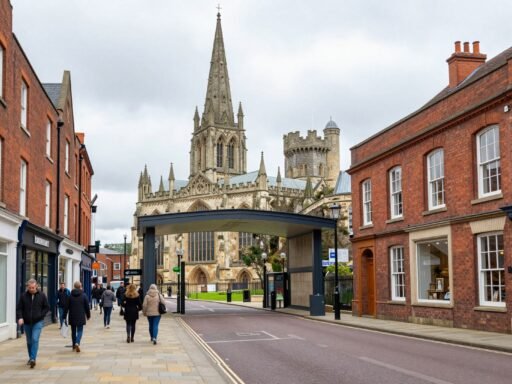
I think the best way to understand Coventry is to look beyond its most famous landmarks. While the cathedral, transport museum and city-centre redevelopment attract plenty of attention, the historic character of gosford street coventry is found in its layers: medieval trade, Victorian industry, wartime survival, music culture and modern regeneration.
Part of the route is known as Far Gosford Street. It sits just beyond Coventry’s inner ring road, near Gosford Green and the Sky Blue Way relief road. At first glance, it may seem like an ordinary urban street. Look more closely, however, and you will find timber-framed buildings, former weaving workshops, traditional pubs, student accommodation and independent businesses.
This guide explains what makes the street important, what to see, how its history developed and how to plan a worthwhile visit. I will also cover the honest drawbacks, including uneven restoration, changing businesses and the fact that some historic buildings are easier to appreciate from outside than enter.
Why Gosford Street matters to Coventry
Gosford Street was historically one of the main routes leading out of Coventry towards Leicester and London. Its name is believed to come from “Goose Ford”, referring to an early crossing over the River Sherbourne.
That location helped the street develop as more than a residential road. It became a busy commercial corridor where craftspeople worked, traded and lived. In the medieval period, wool-related businesses were especially important. Metalworkers and locksmiths were also associated with the street during the thirteenth century, while weavers, drapers, dyers and fullers became increasingly prominent in later centuries.
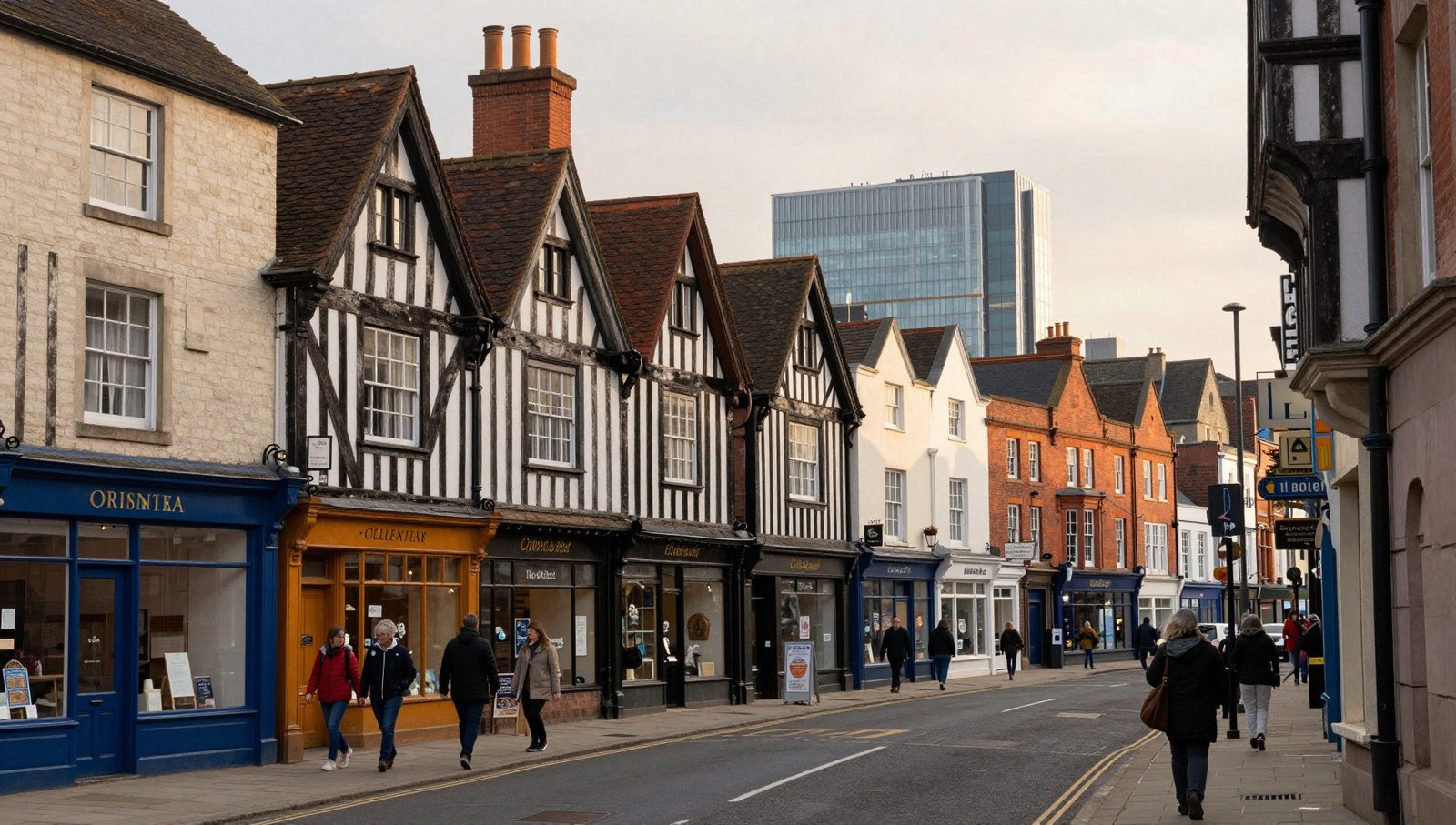
For me, the most interesting feature is the way the street combines different periods without completely losing its identity. A medieval timber frame may sit beside a twentieth-century shopfront, while a restored building may now house a modern business. That contrast is not always perfectly polished, but it makes the area feel genuine.
The street also survived events that transformed much of Coventry. It remained standing through the November 1940 Blitz, when large parts of the city centre were destroyed. Later, it became an important shopping area while the city rebuilt.
Today, the key appeal is this blend of:
- Medieval and early modern architecture
- Coventry’s textile and manufacturing history
- Historic pubs and live music associations
- Independent shops and food businesses
- Heritage-led urban regeneration
A brief history of trade, weaving and industry
Gosford Street’s economic story changed several times. During the medieval period, woollen trades shaped daily life. The street was associated with weaving, wool combing, dyeing and fulling, the process of cleaning and thickening woven cloth.
By the late eighteenth and early nineteenth centuries, silk and ribbon weaving had become especially important. The arrival of Huguenots from France, many of whom had fled religious persecution, helped strengthen Coventry’s textile traditions. Their skills and networks contributed to the growth of silk and ribbon manufacture across the city.
One of the clearest reminders of this period is the group of buildings numbered 67–72 Far Gosford Street. These were “top shops”, a distinctive type of weaver’s house. The upper floor contained a loom and large windows designed to maximise natural light, while the lower floors provided living space for the family.
This arrangement tells us something useful about industrial history: manufacturing was not always separated from domestic life. A family could live, work and earn money within the same narrow building.
After around 1860, weaving declined and other industries took its place. Coventry became increasingly associated with cycle manufacture and motor production. The former Humber Motor building at the junction with Sky Blue Way is one reminder of that transition. Although its later use changed, the structure connects the street with Coventry’s wider reputation as a centre of engineering and vehicle production.
Historic buildings and architectural details
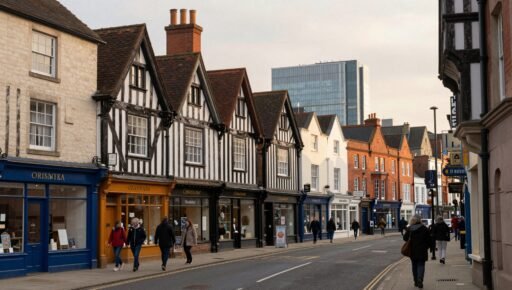
If you enjoy architecture, Far Gosford Street rewards a slower pace. The buildings are not all grand or monumental. Instead, their importance often lies in small details: exposed timber, projecting upper floors, roof shapes, surviving shopfronts and altered elevations.
Several buildings represent the Wealden type. A Wealden building is a medieval timber-framed house with two bays. One bay typically contains a hall open to the roof, while the other has two floors and may project over the street. This projecting upper floor is known as a jetty.
Numbers 32 and 33 are a useful example. Their original construction included oak lath, mud, dung and hair plaster infill panels, although some of these materials were later replaced by brick. The visible timber above the shopfront helps reveal the building’s earlier form.
Numbers 122–124 are also significant. The building may date from the seventeenth century and could have started life as a barn. Some of its timber was reused from older buildings, which is a fascinating reminder that historic construction often involved adaptation rather than complete replacement.
Other notable buildings include:
- Numbers 38–40, linked to a former double-bay house
- Number 41, retaining medieval timberwork behind a later Georgian elevation
- Numbers 67–72, the surviving ribbon-weaving top shops
- Numbers 154–164, formerly connected with Calcott Brothers and now used as student accommodation
- The Gosford Arms, formerly known as the Pitt’s Head Public House
I would recommend looking upwards as well as straight ahead. Upper-storey windows and rooflines often reveal the building’s original purpose more clearly than the ground floor.
gosford street coventry: the highlights to look for
A useful way to explore the street is to treat it as an open-air history trail rather than simply a shopping destination. Start near the western end around Gosford Gate and walk towards Gosford Green. The route is manageable, but I would allow extra time because the most rewarding details are easy to miss.
The main highlights include the following:
| Place or feature | Why it matters |
|---|---|
| Gosford Gate | A useful western reference point near the city centre |
| Gosford Green | A nearby green space that helps explain the area’s layout |
| Numbers 32–33 | A sixteenth-century timber-framed building |
| Numbers 67–72 | Rare surviving ribbon-weavers’ top shops |
| Gosford Arms | A locally listed former public house |
| Hand and Heart | An Arts and Crafts-style pub with music heritage |
| Numbers 122–124 | A likely seventeenth-century timber-framed building |
| Callice Court | Former Calcott Brothers offices, now student accommodation |
The Hand and Heart is particularly important to Coventry’s musical history. The pub became a popular venue for local bands during the 1970s and 1980s, including The Specials and The Selecter. That gives the street a cultural dimension beyond architecture.
The Empire also had an important role as a former cinema and music venue. After its Far Gosford Street lease ended, the venue moved to a larger central location in Hertford Street and opened as HMV Empire in July 2021. Check current listings before planning a music-focused visit, as venues and programmes can change.
A simple walking itinerary
I would plan a visit around two or three hours, depending on whether you stop for food or visit nearby attractions. Begin with a general walk from the inner ring road towards Far Gosford Street. This gives you a sense of how the historic route connects with modern Coventry.
Next, focus on the building details. Pause at the timber-framed properties and compare their proportions. Notice how some upper floors project over the pavement, while other façades were later covered or rebuilt. If you are taking photographs, morning or late-afternoon light usually brings out the texture of timber and brick.
After the architecture, consider stopping at a pub, café or independent business. The available choice can change, so I would check opening times in advance rather than relying on an old online listing.
A practical itinerary could look like this:
- Walk from Gosford Gate towards Far Gosford Street
- Photograph the historic façades and top-shop windows
- Read any available heritage interpretation panels
- Pause near Gosford Green
- Visit a current café, pub or independent retailer
- Continue towards nearby creative and cultural attractions
- Return through the city centre or use local public transport
The street is particularly suitable for visitors who enjoy heritage photography, urban history, architecture and independent businesses. It may be less appealing if you want a large concentration of traditional tourist attractions in one compact location.
How it compares with other Coventry attractions
Far Gosford Street offers a different experience from Coventry’s major museums and landmark buildings. The city centre is better for structured attractions, retail, the cathedral ruins and large cultural venues. Far Gosford Street is more informal and observational.
| Destination | Best for | Overall atmosphere |
|---|---|---|
| Far Gosford Street | Architecture, local history and independent businesses | Historic, mixed-use and informal |
| Coventry city centre | Museums, shopping and major landmarks | Busier and more structured |
| Fargo Village | Creative shops, food and small businesses | Alternative and arts-focused |
| Gosford Green | Relaxing outdoors and local surroundings | Open and residential |
| Coventry Transport Museum | Motoring and engineering history | Educational and family-friendly |
The advantage of Gosford Street is its authenticity. You are walking through a functioning neighbourhood rather than entering a heritage attraction designed entirely for visitors. The downside is that interpretation may be limited, and not every building is open to the public.
This is where expectations matter. I would not visit expecting a fully preserved medieval street. Instead, I would see it as a layered historic environment where old and new sit side by side.
Regeneration, conservation and change
The street’s survival did not guarantee prosperity. After the Second World War, Far Gosford Street benefited from its role as a shopping area while Coventry’s centre was rebuilt. However, the opening of Sky Blue Way in 1986 diverted through traffic and reduced passing trade. Businesses moved away, and some buildings deteriorated.
The Far Gosford Street Conservation Area was declared in 1992. This made the preservation and improvement of the area’s character a planning priority. More substantial economic and physical regeneration began in 2005 through the Townscape Heritage Initiative, supported by heritage funding and Coventry City Council.
Further support came from the European Regional Development Fund and private-sector partners. Restoration projects included historic façades, sensitive new buildings on empty sites and improvements to shopfronts.
Some examples show how challenging conservation can be:
- Numbers 38–40 were restored after partial collapse and neglect
- Number 41 was repaired after fire damage
- Numbers 61–62 were rebuilt in a traditional top-shop style after demolition
- Numbers 65–66 were restored after Blitz damage
- Numbers 121–124 required specialist traditional timber-framing skills
I see this as a qualified success rather than a perfect transformation. Regeneration has protected important buildings and encouraged new uses, but historic streets need ongoing investment. A single restoration project cannot solve vacancy, traffic pressure or changing retail habits.
Pros, cons and practical visitor tips
The advantages
- Strong connection with Coventry’s medieval and industrial history
- Surviving timber-framed and listed buildings
- Links with ribbon weaving and the motor industry
- Historic pubs and live music associations
- Close to Gosford Green and the city centre
- Good location for photography and a self-guided walk
The limitations
- Some buildings are privately occupied or not open to visitors
- Businesses and venue arrangements can change
- The street has a mixed appearance rather than a perfectly preserved historic character
- Traffic and modern urban infrastructure can affect the atmosphere
- More interpretation would help first-time visitors understand what they are seeing
For the best experience, wear comfortable shoes and allow time to look above shop level. Check current opening hours for pubs, cafés and music venues. If you drive, investigate parking in advance instead of assuming that spaces will be available directly outside.
I would also avoid treating the area as a museum. Be respectful of residents, students and businesses, especially when taking photographs. The street’s living character is part of its appeal.
FAQs
Where is Gosford Street in Coventry?
Gosford Street lies on the edge of Coventry city centre, just beyond the inner ring road. Far Gosford Street forms the historic eastern section, near Gosford Green and the Sky Blue Way relief road.
Why is Gosford Street historically important?
It was a major route out of medieval Coventry and developed as a centre for crafts and trade. Its history includes wool, weaving, silk, ribbon manufacture, cycle production and motor engineering.
What are the top shops on Far Gosford Street?
Top shops were houses designed for ribbon weavers. The loom was usually placed on the upper floor, where large windows provided natural light, while the lower levels were used as family living spaces.
Can I go inside the historic buildings?
Some buildings contain pubs, shops or other active businesses, but many are privately occupied. Visitors can usually appreciate the architecture from the street, although access will depend on the current use of each property.
Is Gosford Street suitable for a walking tour?
Yes. A self-guided walk can take around two or three hours if you include photography, food or nearby attractions. The route is most rewarding for visitors interested in architecture, local history and urban regeneration.
What happened to The Empire music venue?
The former Empire venue on Far Gosford Street relocated to a larger and more central site in Hertford Street after its lease expired. It opened as HMV Empire in July 2021, although visitors should check current event information before travelling.
What is the best time to visit?
Daylight hours are best for seeing timber frames, upper-storey details and shopfronts. Late morning or afternoon may suit visitors who want to combine a heritage walk with lunch or shopping, but opening times vary.
Conclusion
Gosford Street is one of Coventry’s most revealing historic routes because it tells several stories at once. Its origins lie in a medieval crossing and an important route out of the city. Its buildings preserve evidence of weaving, domestic industry and later manufacturing. Its pubs and venues connect the area with Coventry’s music scene, while regeneration projects show how heritage can support a changing neighbourhood.
My main advice is simple: slow down, look above the shopfronts and visit with realistic expectations. This is not a frozen historic attraction, and that is precisely its strength. It is a living street where timber-framed houses, modern businesses, student accommodation and public spaces share the same setting.
For anyone interested in Coventry history, listed buildings, independent culture or thoughtful urban regeneration, gosford street coventry is well worth adding to a city visit.